Key Takeaways
- White GSDs are not albinos; they have normal dark eyes and skin, but carry an 'e/e' masking gene that hides black/tan pigment.
- The AKC registers them as purebreds, but they are disqualified from conformation dog shows.
- Their white coat shows dirt and tear stains very easily, making them higher maintenance than standard colors.
There’s a white German Shepherd banned from the AKC show ring sitting in someone’s living room right now, doing everything a “proper” GSD does — protecting the house, learning commands in two training sessions, herding the family’s children around the yard.
The dog has no idea it’s considered a “fault.” Neither do the people who love it.
White German Shepherds exist at the intersection of genetics, show ring politics, and a century of breed standard debate. The facts are more interesting — and more nuanced — than the online arguments suggest.
The Albino Myth: Let’s Clear This Up First
White German Shepherds are not albinos. This is the most persistent and damaging misconception about the color.
True albinism is caused by a complete absence of pigment-producing melanocytes. Albino animals have pink or red eyes, pink skin, and no pigmentation anywhere. They’re often photosensitive and prone to vision problems.
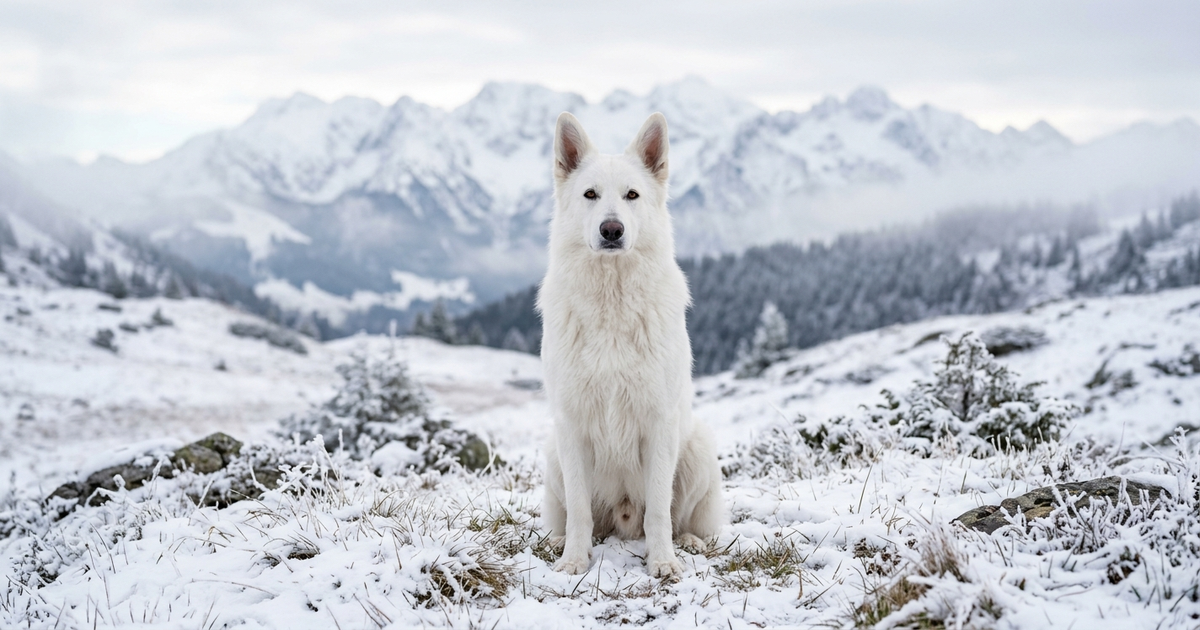
White German Shepherds are none of these things. Look at any white GSD closely:
- Eyes: Dark brown or amber — fully pigmented
- Nose: Black — fully pigmented
- Skin: Normal, pigmented skin under the white coat
- Vision: Normal
What white GSDs have is a masking gene at the MC1R locus (the “Extension” locus), specifically an “e/e” genotype. This gene doesn’t eliminate pigmentation — it masks the expression of other colors, causing the coat to appear white while the dog’s underlying genetics remain identical to any other GSD.
The difference matters: albinism is a health condition. White coat in GSDs is a color variant — nothing more.
🔍 Reddit Insight: On r/germanshepherd and r/dogs, the albino misconception comes up constantly. White GSD owners report being told by strangers and even some veterinarians that their dog “must have been inbred” or that the white coat signals health problems. Experienced GSD community members consistently shut this down: “Same dog. Different pigment expression. That’s it.” The confusion likely persists because white animals in general are sometimes associated with albinism in popular culture.
The AKC Disqualification: Why It Happened and What It Actually Means
In 1968, the German Shepherd Dog Club of America (GSDCA) voted to add white as a disqualifying fault for conformation shows. This means a white GSD cannot compete in AKC breed conformation — the judging events where dogs are evaluated against the breed standard.
This was controversial then, and remains controversial now. The decision was political as much as genetic: white GSDs had been present in the breed since its foundation (one of Horand von Grafrath’s direct ancestors, Greif, was white), and the color had been selectively discouraged in Germany starting in the 1930s.
What the AKC disqualification does and doesn’t mean:
| AKC Conformation | ❌ White GSDs cannot compete |
|---|---|
| AKC Registration | ✅ White GSDs can be registered as purebreds |
| AKC Performance Events | ✅ Fully eligible: obedience, agility, tracking, herding |
| UKC Recognition | ✅ Fully accepted and competitive |
| International | ✅ The FCI recognizes the Berger Blanc Suisse as a distinct breed |
The disqualification is a show ring rule, not a quality judgment. A white GSD with a fully AKC-registered pedigree is every bit as purebred as its saddle-patterned relatives.
🔍 Reddit Insight: r/germanshepherd discussions about white GSDs often surface frustration from owners who encounter breeders “warning” them away from white dogs as defective or poorly bred. Experienced members clarify that the AKC disqualification created a two-tier perception problem: show breeders actively avoided white, which meant for decades white GSDs were less rigorously health-tested. That’s not a genetics problem with the color — it’s a breeder practice problem. Today, finding white GSD breeders who do full OFA hip and elbow screening is entirely possible, you just have to look for them specifically.
Genetics: How the White Coat Is Inherited
The white coat in German Shepherds works differently than the sable, saddle, or black patterns.
- Responsible gene: MC1R locus (Extension locus), “e/e” genotype
- Mechanism: The recessive “e” allele prevents eumelanin (black pigment) from depositing in the coat, resulting in a white or cream appearance
- Inheritance: Two copies required — both parents must carry the “e” allele; carrier parents show normal colors
This gene is genetically entirely separate from the A locus that controls sable/saddle/black patterns. A white GSD still carries underlying A-locus genetics — it may be genetically sable or saddle underneath, just masked by the e/e extension.
Practical implication: A white GSD bred to a standard-colored GSD can produce white puppies if the standard-colored parent is a carrier. Breeders trying to predict white offspring in litters need to know the Extension locus status of both parents.
Temperament and Health
Temperament: White GSDs have the same temperament range as any GSD — determined by bloodline, not coat color. The white masking gene has no known influence on personality, drive, or trainability.
The typical white GSD available from breeders today tends to come from show-line stock, making them generally calmer and more family-oriented than working-line dogs (learn which type of GSD matches your lifestyle). But this is a bloodline trend, not a color trait.
Health: No health conditions are directly caused by the white masking gene. The concerns you might encounter are:
- Photosensitivity: Not a documented concern for white GSDs (unlike true albino animals)
- Hip dysplasia: Same risk as any GSD — dependent on breeding quality, not color
- Deafness: Not genetically linked in German Shepherds the way it is in some other white-coated breeds (Dalmatians, Boxers)
Always ask for OFA hip and elbow certifications regardless of coat color. This is non-negotiable with any GSD.
Grooming Reality: White Is Not Low-Maintenance
Here’s the honest part most articles skip: white GSDs show dirt, stains, and grass markings immediately.
The dramatic white coat requires:
- Brushing 3–4 times per week (same as any GSD)
- More frequent bathing than other GSD colors — grass stains, soil, and food residue are very visible on white
- Attention to tear staining around the eyes (reddish-brown discoloration from porphyrin deposits)
- White-coat-specific shampoos that maintain brightness without stripping coat oils
In terms of shedding volume, white GSDs shed just as much as any other GSD. The hair is just white — which shows dramatically on dark furniture and clothing.
The White Shepherd as a Separate Breed
In some countries, the story goes in a different direction entirely.
The Berger Blanc Suisse (White Swiss Shepherd) is recognized by the FCI (Fédération Cynologique Internationale) as a distinct breed, developed from white GSD lines in Switzerland and Canada. The UKC similarly recognizes the “White Shepherd” as its own breed category.
If you live outside the US or want to compete internationally in conformation events, the white coat may open doors rather than close them.
Should You Get a White German Shepherd?
Great fit if:
- You want an AKC-registered, fully purebred GSD in a striking white coat
- You plan to compete in performance events (agility, obedience, tracking) — no restrictions apply
- You’re comfortable explaining to everyone that your dog is not albino and not a mix
- You can handle white hair on every dark surface you own
Reconsider if:
- AKC conformation showing is a goal — the color disqualifies
- You want minimal grooming to keep the coat looking clean
- You prefer a dog that doesn’t attract constant attention and questions in public
Frequently Asked Questions
Are white German Shepherds recognized by the AKC?
They are registered by the AKC as purebreds but disqualified from conformation competition since 1968. They’re fully eligible for all AKC performance events.
Do white German Shepherds have more health problems?
Not inherently. The white masking gene itself isn’t linked to any health conditions. Health risk depends entirely on the breeding quality and health testing of the specific bloodline.
Are white German Shepherds rare?
Relatively. Both parents must carry the recessive e allele, and since show line breeders have largely avoided the color, the gene pool is smaller. Expect waiting lists and prices of $1,500–$3,500 from reputable breeders.
Can a white German Shepherd work as a police or service dog?
Absolutely. Coat color has no bearing on working ability. White GSDs serve in search and rescue, as service dogs, and in therapy work around the world.
Ready to find your perfect GSD match?
Take our 2-minute behavioral quiz. We'll match your lifestyle (and patience level) with the exact GSD bloodline and coat type you need — before you bring home a land shark.
Take the Matching Quiz →